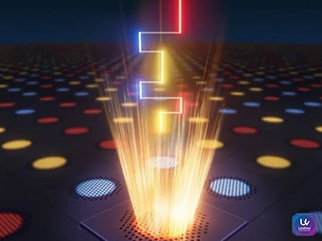




A tiny cavity traps light strongly but swaps energy well, allowing steady multi-state light use.
BY Mahnoor | 27-07-2026
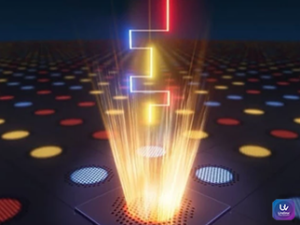
A group of scientists made a light beam show three stable states inside a tiny silicon device, just 20 micrometers wide, thinner than a human hair. This was reported in a new study in the journal Nature Nanotechnology.
Giving a light beam a third state, beyond just ‘on’ and ‘off’, is a big step towards making photonic computers work in real life.
Researchers from Peking University in Beijing and Harbin Engineering University in northeast China made a system that can stay in many stable states, needing only 240 microwatts to switch between them. This is less power than a normal laser pointer uses. They built a first-of-its-kind optical memory device that can store multiple values using this method.
Tristability is a type of multistability. Multistability means a system can keep multiple stable states under the same settings and outside conditions, and can switch between these states with outside triggers or changes.
When talking about light, multistability means that one storage unit can keep more data.
This is very important for light-based computers and storing data with light. But on tiny chips, light’s non-linear effects are very weak, so it’s hard to make devices that can hold light in multiple states steadily.
To fix this problem, the researchers used a physics trick called ‘near-exceptional-point coupling.’
They made two wave patterns in a tiny light trap. When the system is pushed toward a special state called an “exceptional point,” the two patterns connect strongly, with their colors getting closer and their widths matching.
This state lets the tiny trap hold light tightly while sharing energy well with the outside, making it possible for light to have multiple steady states.
In the test, the tiny trap made by the researchers had a quality score of one million, letting light bounce inside many times before fading slowly. With a very low power input of 240 microwatts, the system showed clear three steady states.
By carefully adjusting the input light power or wavelength, the system can quickly and reliably switch between three states.
This study shows that with clever physical design, even on a very small silicon chip, light’s nonlinear effects can be controlled and made to show many different stable states.
This gives a new basic part for building future optical neural networks and brain-like computers that can handle more complex information.
Also watch this :